
Train Communication Networks
The core of TCMS
The EKE-Trainnet® Train Communication Network (TCN) forms the core of the TCMS and complies with the IEC 61375 Series.
It provides the communication infrastructure that enables data exchange across the entire train. Sub-systems communicate through one shared network or several coordinated networks when project requirements demand it.
Centralised control becomes possible through this unified architecture.

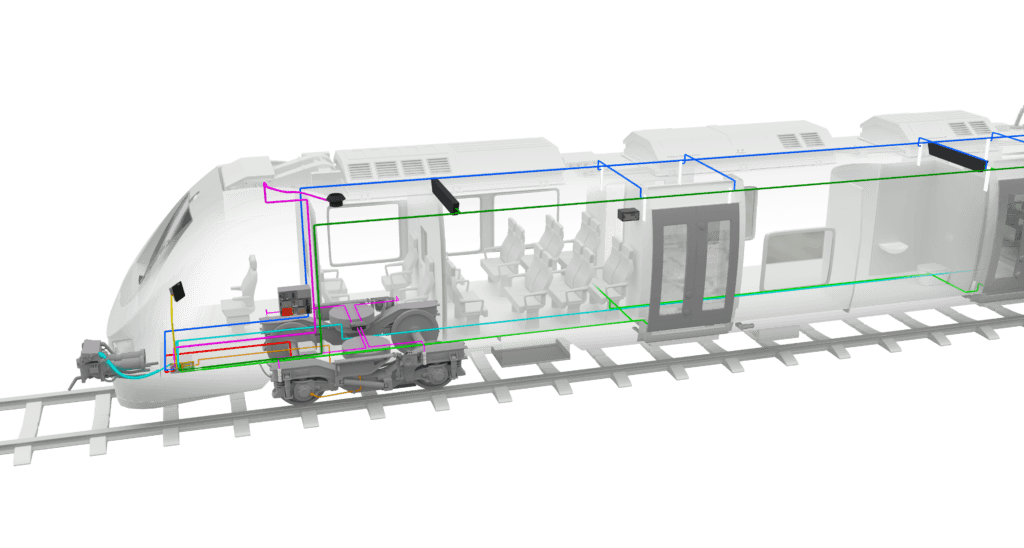
Train Communication Network Structure
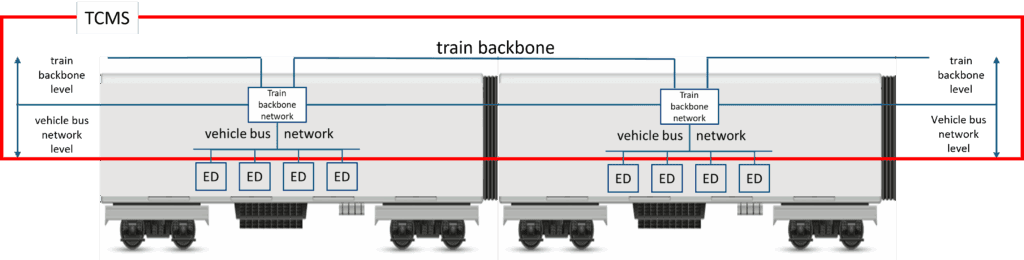
The EKE-Trainnet® TCN architecture typically includes two communication layers.
- Vehicle Bus: handles intra‑vehicle communication
- Train Backbone Network: manages train‑wide information exchange.
Common Bus Technologies
Ethernet Adoption in Modern Rolling Stock
Ethernet-based solutions, such as Ethernet Train Backbone (ETB) and Ethernet Consist Network (ECN), continue gaining traction in TCMS applications. These technologies provide a larger bandwidth for complex data flows.
Dual-Homing, TRDP & SDTv2 Included
The platform supports a dual homing network topology to provide redundancy and high availability in operation. It supports the TRDP protocol enabling data exchange between devices from different manufacturers on Ethernet networks. SDTv2 (Safe Data Transmission version 2) is supported together with TRDP to enable the safe transmission of safety related data over Ethernet/IP train networks. This provides integrity protection and fail-safe
behaviour when standard TRDP alone does not meet safety requirements.
TCN Key Features

Supports multiple interface technologies
- Train computers, also known as Gateways, link coaches and subsystems through a unified network.
- Supported interfaces include WTB, MVB, CAN, Serial Links, and Ethernet.
- Multiple bus technologies can operate at the same time across a single train.
- Suitable for both new trains and fleet modernisations.
- Enables either a single integrated network or several independent networks.
- Offers a cost‑efficient architecture that connects all train subsystems.
Compatible With proprietary protocol
- Integrates proprietary protocols without restricting project needs.
- Supports dual‑homing for increased reliability and performance.
- TRDP and SDTv2 are supported across the platform.
- SDTv2 supports applications requiring SIL 2 certification.
Centralised network with full control
- System data is accessible across the network, including from remote locations such as depots.
- Unlike traditional architectures with one central computer, EKE‑Trainnet® distributes applications and logs across all cars.
- Each car runs its own applications and records its own alarms and faults, improving system resilience.
- A failure in one computer does not impact the functionality of other cars.
Examples of Train Communication Network architecture
EKE‑Trainnet® solutions deliver high versatility and support multiple Train Communication Network (TCN) architectures. These architectures suit a wide range of operational and technical requirements.
- Full MVB train
- Full CAN train
- Dual Homing TRDP Ethernet
- Ethernet-WTB-MVB
- Ethernet-MVB Hybrid
- WTB-MVB standard bus redundancy, no redundant I/O
- Dual Homing TRDP
- Ethernet-WTB-MVB Hybrid
- CAN-WTB
Frequently Asked Questions
What is a TCN?
A TCN or Train Communication Network exchanges information throughout the train. A Vehicle Bus is used for intra-vehicle communication. A Train Bus is for train-wide connectivity. The TCN typically consists of interconnected train computers, or Gateways, linked to various subsystems.
Click here to read our blog “What is a Train Communication Network (TCN)?” for more information.
What kinds of TCN architectures can EKE-Electronics implement?
EKE-Trainnet® solutions are highly versatile. They implement various Train Communication Network (TCN) architectures to meet different operational and technical requirements. Below are examples of possible architectures, illustrating the range of configurations we can provide. These examples do not cover every possibility but demonstrate the flexibility and scalability of our solutions.
- Full MVB train
- Full CAN train
- WTB-MVB standard bus redundancy, no redundant I/O
- Ethernet-WTB-MVB
- Dual Homing TRDP Ethernet
- Dual Homing TRDP Ethernet-WTB-MVB Hybrid
- Ethernet-MVB Hybrid
- CAN-WTB