
The Train Communication Network (TCN) is the backbone of a Train Control and Management System (TCMS). It provides the communication infrastructure that links the various control units and subsystems across the train. A TCN supports functions that include control, monitoring, diagnostics, and passenger‑facing services.
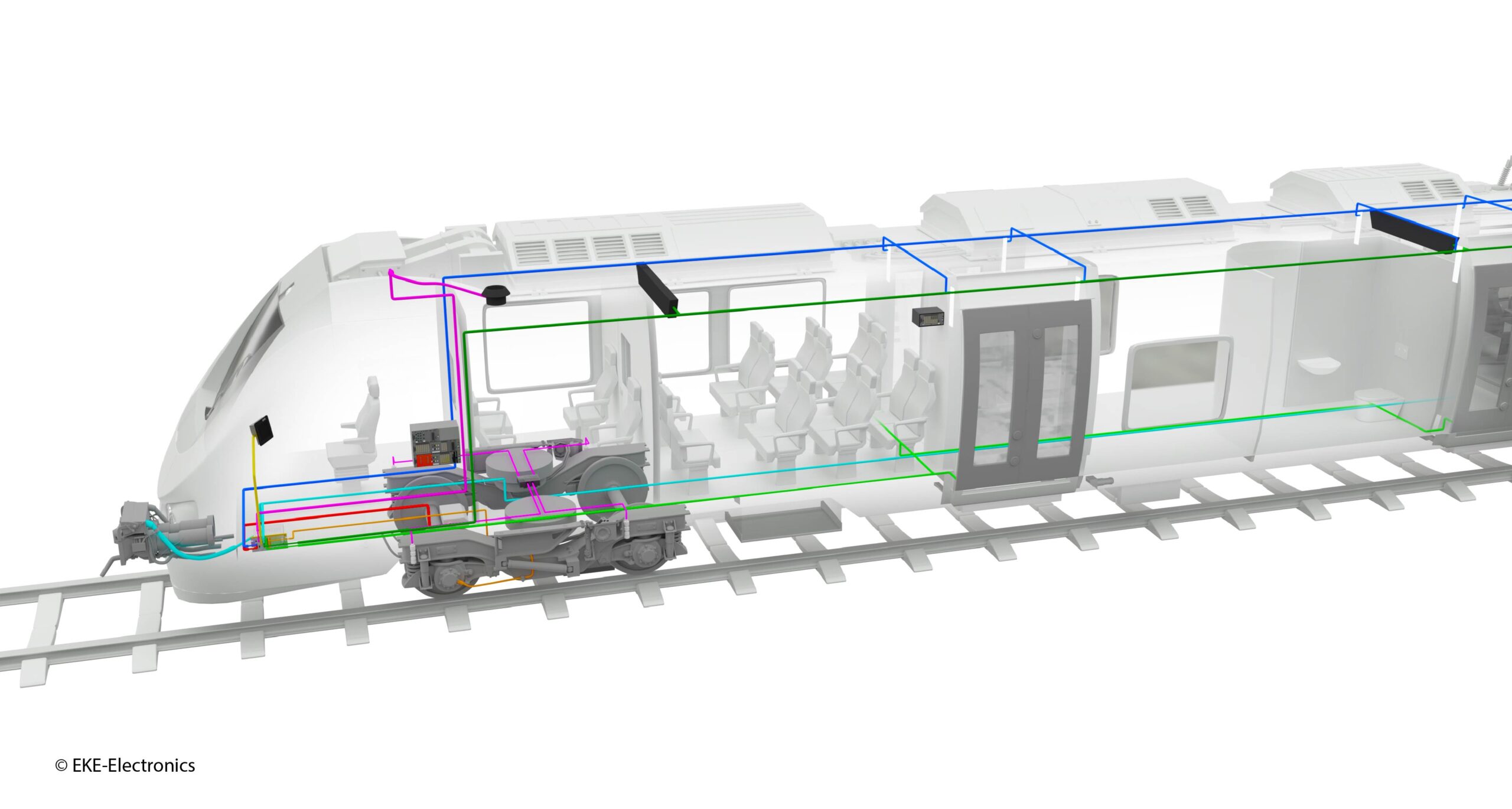
Core Functions of a TCN
The TCN performs the following actions:
- Transmission of control commands to subsystems
- Communication between vehicle control units in a consist
- Real-time control and monitoring of critical systems.
- Collection of diagnostic and status data
- Interfacing with passenger information, safety functions, and selected external networks
- Support safety-critical applications with deterministic communication protocols.
Modern Ethernet‑based networks also support IP‑enabled devices, condition monitoring, and enable over-the-air updates.
TCN Architecture
A TCN uses a hierarchical structure that separates vehicle‑level communication from train‑wide communication. This structure improves modularity and system reliability.
- Train Backbone Network (TBN)
Connects different vehicles (or cars) in the train. It enables communication between the TCMS and other systems located in each car.
- Vehicle Bus Network (VBN)
Connects subsystems within a single vehicle. This allows local control and monitoring at the vehicle level.
Key TCN Components
The key components of a train communication network are shown in the diagram below.
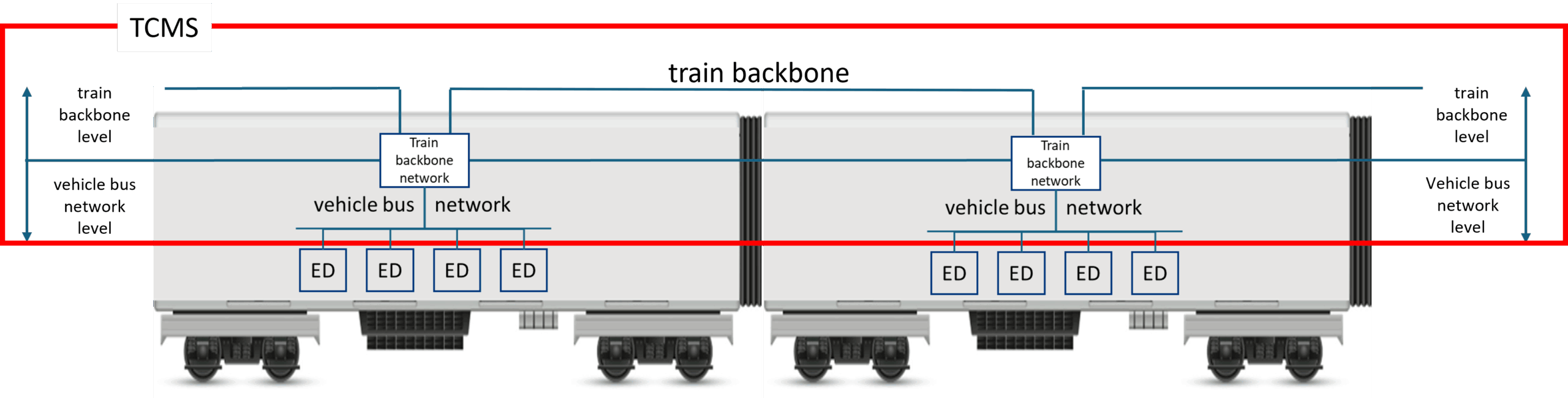
ED = End Device i.e. HVAC, Doors, traction equipment
Train Control and Management System (TCMS)
The TCMS acts as the central control and coordination system. It manages data exchange across all communication layers. It interfaces with both train-wide and vehicle-level networks. The TCMS handles diagnostics and issues control commands to various subsystems.
Gateways
Gateways enable communication between different network technologies or protocols. They translate messages to ensure interoperability. They are particularly important in refurbishment projects where legacy and modern systems must work together.
Communication Controllers and Switches
Communication controllers manage network traffic. Ethernet switches, WTB gateways, and MVB repeaters ensure reliable data routing. They support features such as redundancy and traffic prioritisation.
Cabling and Connectors
Cables and connectors provide the physical communication layer across the train. Railway‑grade components offer resistance to vibration, fire, and electromagnetic interference.
Human-Machine Interfaces (HMI)
HMIs include driver displays, diagnostic screens, and maintenance terminals. They allow operators and service personnel to monitor and interact with onboard systems.
Common TCN Technologies
Modern TCMS rely on robust and efficient communication networks. These ensure safe, coordinated, and responsive operation across all onboard systems. Several communication technologies have been adopted in the rail industry. Each has its own role, technical characteristics, and level of suitability for different applications.
Wire Train Bus (WTB)
Used for communication between vehicles.
- Serial, master/slave architecture with built-in redundancy
- Linear daisy-chain topology supporting up to 32 nodes
- Often vendor-specific and based on fixed configurations
- Primarily found in older fleets
Multifunction Vehicle Bus (MVB)
Used as communication with a single vehicle.
- Deterministic and time-triggered communication
- Supports a large number of devices (up to 4096 predefined addresses)
- Suited for safety-critical and real-time control systems
- Common in legacy and some new fleets due to reliability
Ethernet (ETB / ECN)
Increasingly used as the train backbone of new fleets.
- Switched IP-based communication
- Bandwidth from 100 Mbps to 1 Gbps
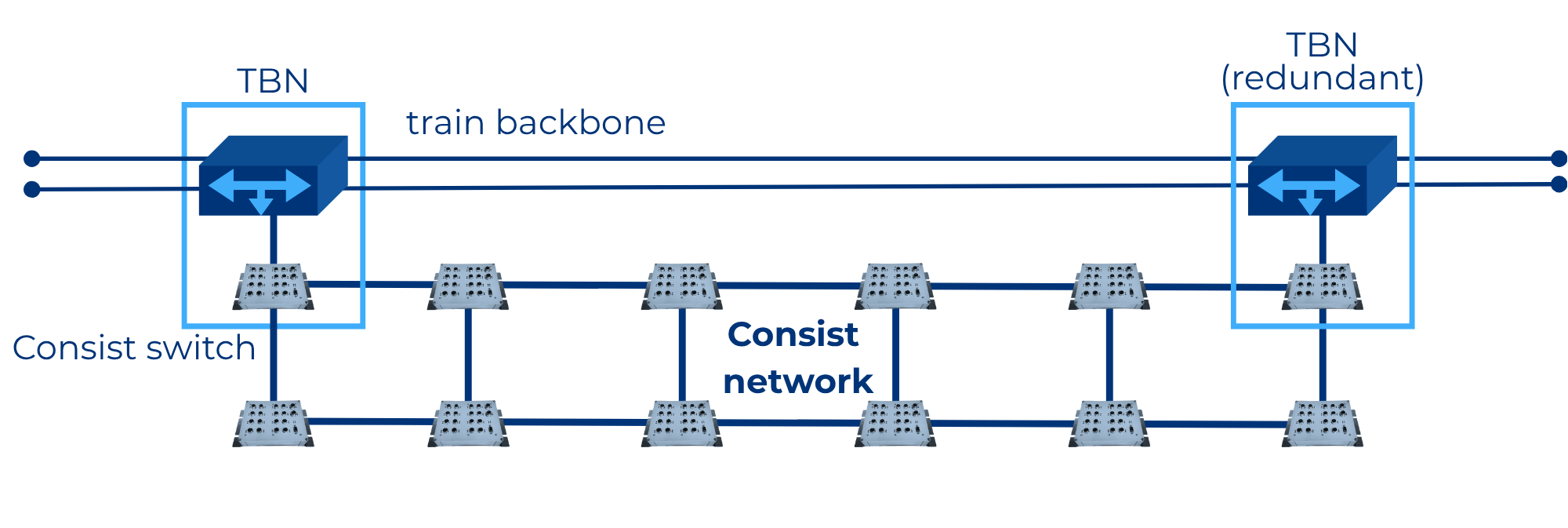
- Supports ring and ladder topologies for redundancy
- Highly scalable with dynamic configuration
CAN (e.g., CANopen)
Used at the field level.
- Event-triggered communication
- Typical data rates from 125 kbps to 1 Mbps
- Supports around 100 devices per network
- Still relevant for subsystem control despite legacy status
Serial Links (e.g., RS-485)
Found mainly in older systems.
- Point-to-point or multidrop connections
- Low data rates, typically up to 115 kbps
- Minimal redundancy
- Often vendor-specific protocols
In practice, many trains use a mix of these technologies, with gateways bridging different protocols to form a unified network.
Network Topologies Used in Trains
Network topology describes how devices are arranged and connected. Each topology offers different benefits and limitations.
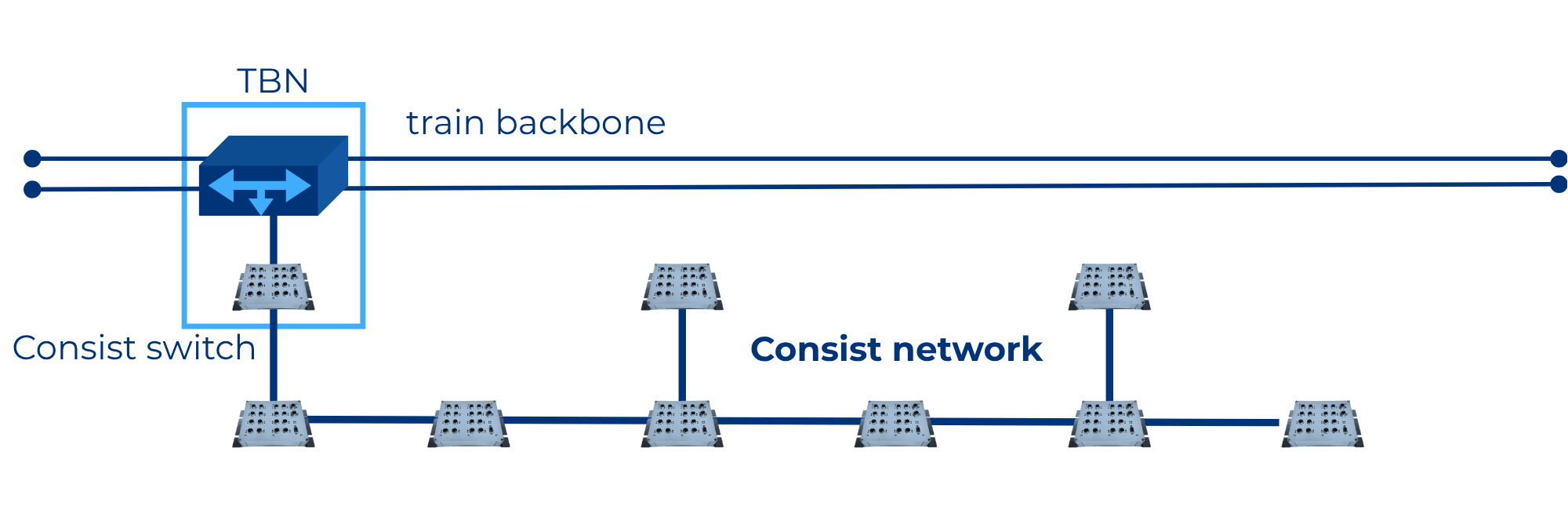
Tree Topology
Devices are connected in sequence along a single communication path. This is typical for train-wide systems such as the WTB, where carriages are connected in a daisy-chain manner.
- Advantages: Simple to implement across cars
- Limitations: A fault in one segment can disrupt the entire line if redundancy is not implemented
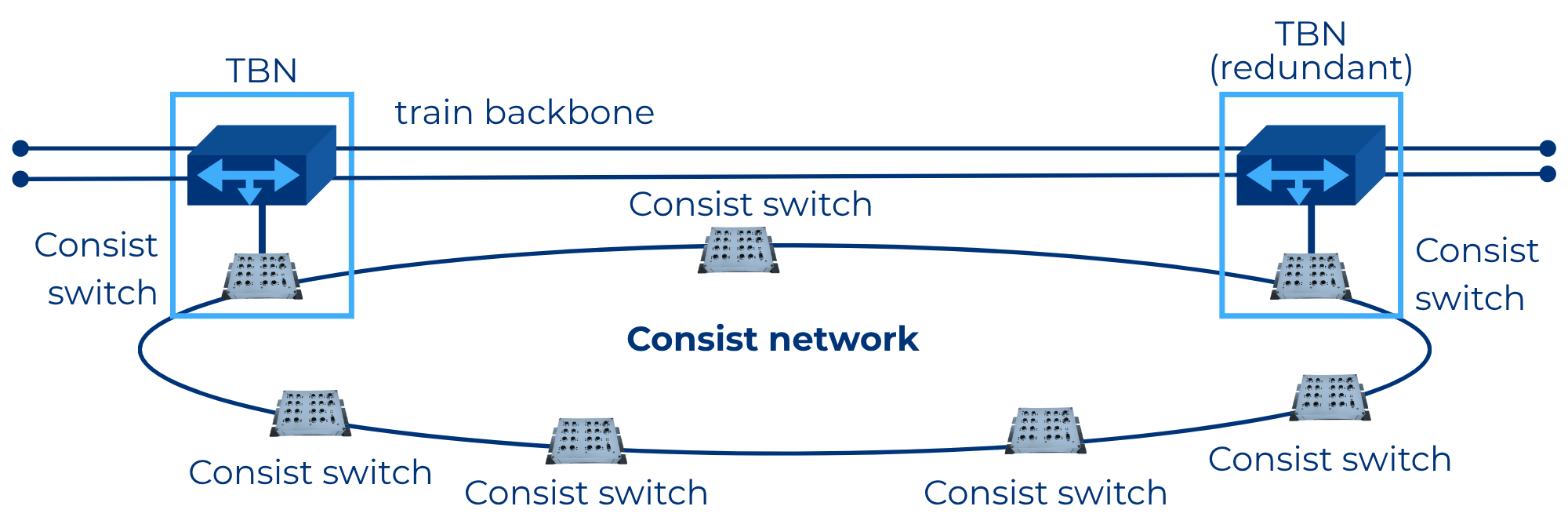
Ring Topology
Devices form a closed loop, allowing data to travel in both directions. Used in some ETB with redundancy protocols such as RSTP or MRP.
- Advantages: High fault tolerance, so communication can continue if one segment fails
- Limitations: More complex configuration and higher component count
Ladder Topology
Devices are connected in a hierarchical structure resembling the rungs of a ladder.
- Advantages: Easy to scale and isolate faults
- Limitations: A fault in one segment can disrupt the entire line if redundancy is not implemented
Redundancy and Reliability
Redundancy is a critical aspect of train communication network design, ensuring continued operation in the event of a fault or hardware failure.
TCNs typically include:
- Redundant topologies and devices to ensure continued operation in the event of a failure
- Hot standby configurations for critical nodes, such as TCMS central units
- Deterministic communication (especially on MVB) to support real-time control tasks
Modern Ethernet-based TCNs also include mechanisms to ensure Quality of Service (QoS), network segregation (e.g., VLANs), and prioritised message handling.
Standards Governing TCN
Key standards include:
- IEC 61375 – Communication network and protocol architecture
The TCN is standardised under:
- IEC 61375-1: General architecture and principles
- IEC 61375-3-1 (MVB) and IEC 61375-3-3 (CANOpen): Legacy and low-level field buses
- IEC 61375-2 series: Ethernet Train Backbone (ETB), Ethernet Consist Network (ECN), and related management protocols
These standards promote multi-vendor interoperability, allowing systems and components from different suppliers to work together reliably in the same vehicle.
Integration with Safety Applications
Yes. Safety applications in a Train Communication Network are implemented using safety-certified hardware and software developed in accordance with railway standards such as EN 50126, EN 50716 (previously EN 50128), and EN 50129. They rely on safe communication protocols such as SDTv2 (defined in IEC 61375-2-3). Communication protocols, such as MVB or Ethernet and incorporate safety layers that ensure reliable message delivery through error checking, sequencing, and timeouts. These applications are often segregated from non-safety functions and undergo rigorous validation and monitoring to ensure predictable and fail-safe operation of critical systems such as Automatic Selective Door Operation (ASDO), Hot Axle Box Detection and Vigilance Control System.
Cybersecurity Requirements in TCN Design
As trains become more connected, cybersecurity has become a core requirement rather than an optional feature. Modern TCNs must address several risks:
- Legacy limitations: Older networks were not designed with authentication, encryption, or secure updates, leaving them vulnerable to modern cyber threats.
- Expanded attack surface: Ethernet backbones, remote monitoring, and IP-enabled subsystems introduce new entry points that must be protected.
- Regulatory pressure: Standards such as the EU Cyber Resilience Act push manufacturers toward security‑by‑design.
- Operational impact: Suppliers and integrators must implement lifecycle risk management and compliance traceability across all network nodes.
In modern train systems, cybersecurity is no longer a bolt-on. It’s a foundational element of resilient, future-ready train control infrastructure.
Design Considerations for TCNs
Designing a TCN requires balancing system requirements, lifecycle expectations, and long‑term serviceability. Key points include:
- Functional purpose: The network must support each subsystem’s timing, bandwidth, and reliability needs without overdesigning or introducing unnecessary complexity.
- Architecture and technology choice: Selecting the wrong protocol, for example, one with insufficient bandwidth, can lead to communication bottlenecks or future upgrade constraints.
- Reliability and redundancy: Critical systems may require duplicated communication paths or hot‑standby controllers to maintain availability.
- Scalability and integration: The design should support future enhancements, refurbishment cycles, and integration of both modern and legacy equipment.
- Ease of maintenance: A well‑structured TCN reduces wiring, simplifies troubleshooting, and ensures stable data exchange across the vehicle.
With 40 years of experience in new build and refurbishment projects, EKE‑Electronics delivers modular, field‑proven systems. The EKE‑Trainnet® TCN gives you centralised control of the whole network, with remote access from any location.