Vehicle Contol Unit
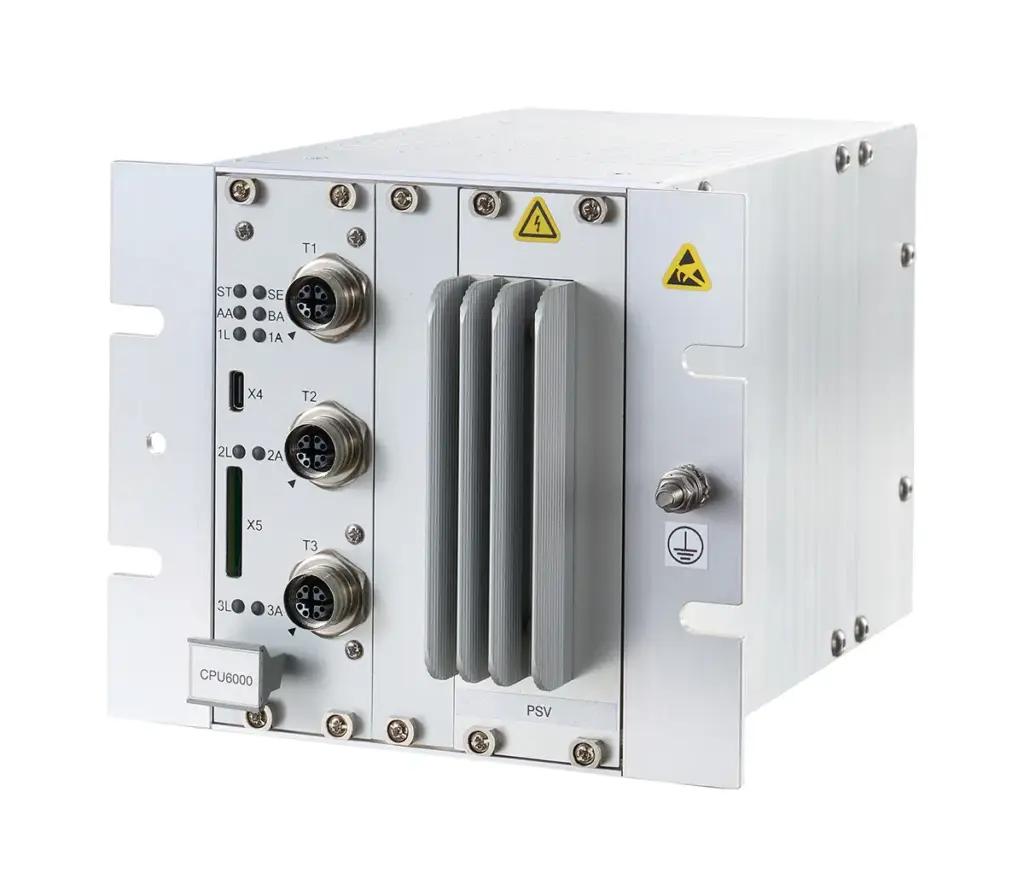
EKE-Trainnet® Vehicle Control Unit can connect with sub-systems and the Train Communication Network, providing advanced control and diagnostic functions. Our modular design and customisation provide tailored solutions, while our integration expertise and advanced diagnostics ensure exceptional performance and reliability. The EKE-Trainnet® Vehicle Control Unit can be certified to SIL 2.
VCU Key Features
High performance
High data throughput, supporting realtime control, stable system behaviour, and efficient handling of complex train functions.
Dual homing
Two redundant Ethernet interfaces that keep communication running even if one network path fails.
Integrated local I/O capability
Combine vehicle control and local I/O in a single compact rack allowing one processor to run both the VCU functions and the I/O handling.
Multiple bus interfaces supported
WTB, MVB, CAN, Serial Links and Ethernet supported.
GoA 4
Built for Grade of Automation (GoA) up to Level 4 in compliance with EN 62290.
Cybersecurity for VCU applications
Our Vehicle Control Units use a cybersecurity architecture that meets IEC 62443-4-2 Security Level 2 and aligns with EU Cyber Resilience Act principles for secure-by-design operation.
The platform is built on the same next-generation CPU line used across the TCMS family, providing a hardened processing environment designed to resist tampering and unauthorised software through a cryptographically protected secure-boot chain. Combined with secure communication methods, controlled access, and long-term lifecycle support, the VCU provides a dependable and trustworthy base for secure train control.
Typical applications for the Vehicle Control Unit include:
Build Your Own Applications
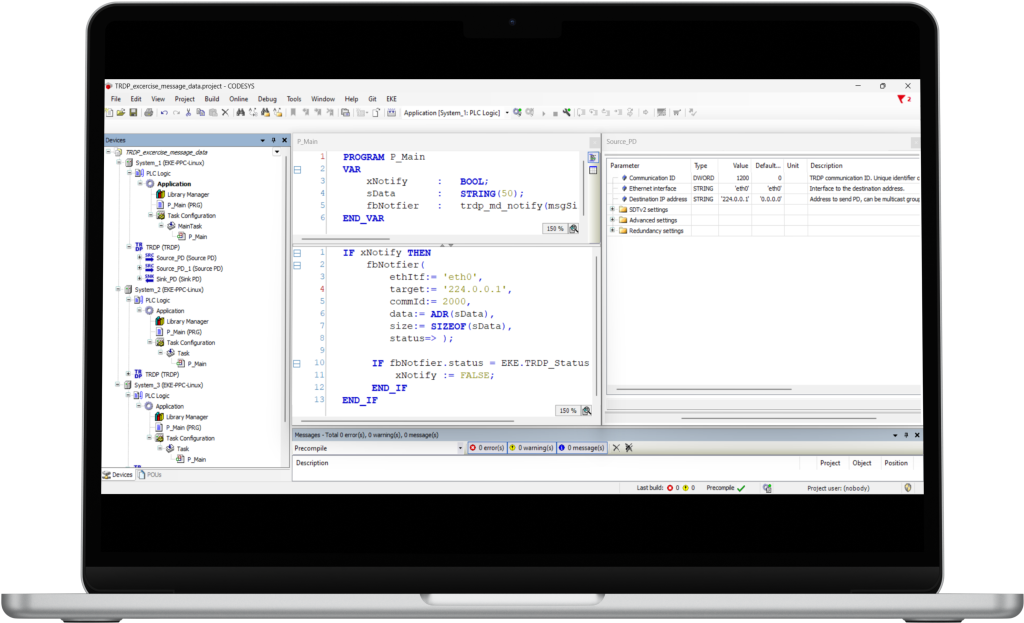
EKE-Trainnet® Vehicle Control Unit is built on an open-source Linux platform powered by CODESYS®. It allows you to develop custom applications.
If you prefer to develop in-house. EKE-Electronics provides training, tools, and guidance to support your development efforts. Alternatively, EKE-Electronics has expertise to develop fully or partially software on your behalf.
Build a Vehicle Control Unit using the following modules
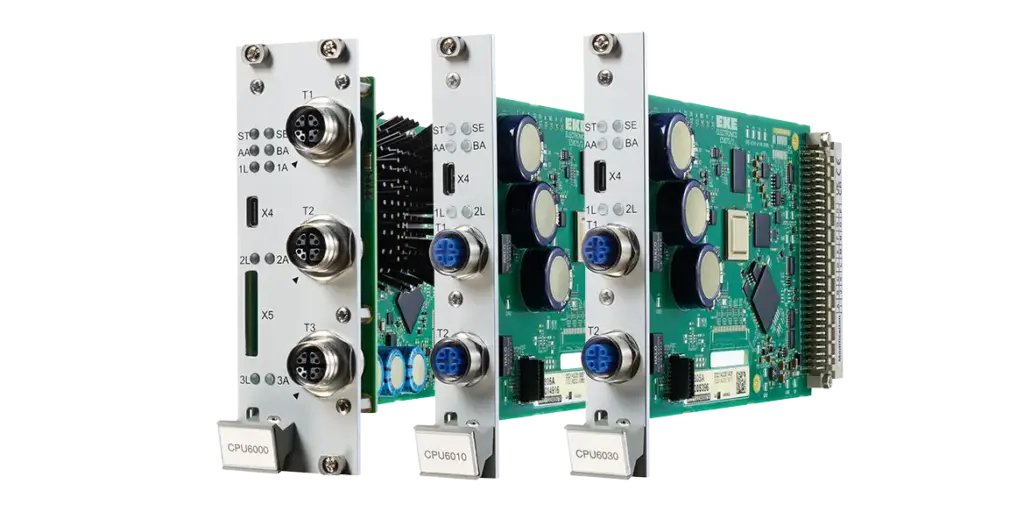
EKE-Trainnet® Vehicle Control Units can control any train sub-system, such as brakes or doors. It can be used for both physical control and diagnostics of train sub-systems. The following modules are required to create the Vehicle Control Unit. Click on an image to explore related content.
Modular Concept
All our EKE-Trainnet® products are modular, enabling you to precisely select the modules you require. Modules can be combined for a very flexible and versatile solution. The modular design enables you to select only the features you need for a cost efficient solution. It also means repairs and upgrades are quick and easy.
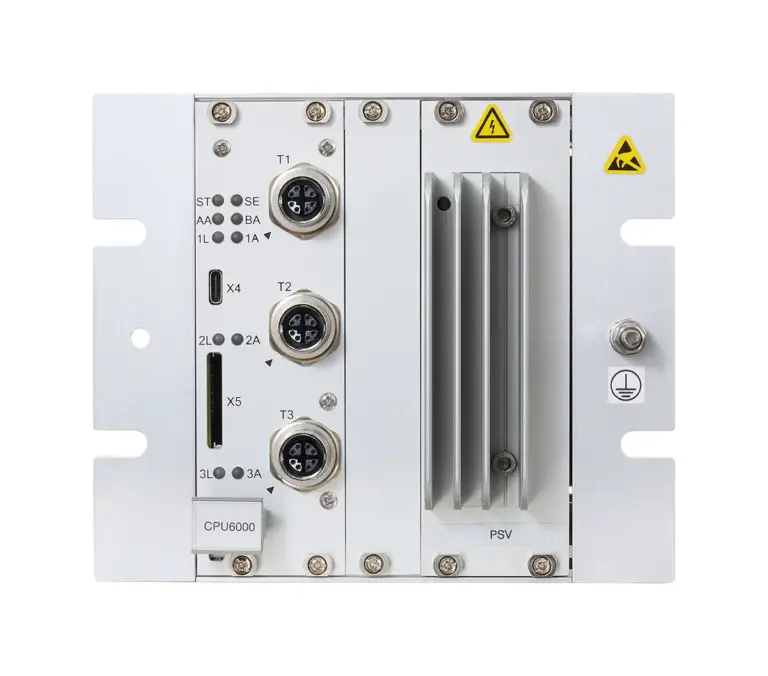
Below is an example of a Vehicle Control Unit made up of a selection of common modules. Hover over each area to view a brief description or click to access the full module page.
Digital Input Output Module (DIO)
Receives digital signals through its input channels and delivers them to the train computer’s Central Processing Unit (CPU) module for processing.
Pt100/Pt1000 Temperature Sensor Input Module (PTI)
Used to acquire the signals from the Pt100 (PTI2037) or Pt1000 (PTI3593) temperature sensors (resistance measurement) and convert them into temperature values expressed in degrees Celsius.
Analogue Input Module (AIM)
Converts analogue signals and makes them available to the train computer’s CPU module.
CPU with Serial Links (CPS)
A central processing unit providing serial communication interfaces.
Multifunction Vehicle Bus Interface Module (MVB)
Used to create vehicle buses or train communication networks.
Power Supply Unit for VME (PSV)
A power supply unit required to power the vehicle control unit.
Vehicle Identification Unit (VIU)
Provides an interface for the Electronic Serial Number (ESN) for device identification and configuration.
Why Choose EKE-Electronics for Vehicle Control Units?
The EKE-Trainnet® Vehicle Control Unit (VCU) is a robust and adaptable system based on an open-source Linux platform. It supports the development of safety applications up to SIL 2. The modular design allows for customisation to meet specific requirements, while its open architecture facilitates the integration of third-party hardware and software. Advanced diagnostics and system monitoring enhance reliability and performance.
Modular design and customisation
Our EKE-Trainnet® VCUs are built by selecting the most suitable modules from our EKE-Trainnet® range to meet your requirements. The open-source platform provides different approaches for customisation and integration.
Advanced control and diagnostics
Controlling various train subsystems such as brakes and doors, the EKE-Trainnet® VCU manages both physical functions and diagnostics. These applications can run on the same train computers used for TCN Gateway functions, providing a compact and cost-effective solution.
Supports a range of interfaces
EKE-Trainnet® VCU supports a range of bus technologies, including WTB, MVB, CAN, Serial Links, and Ethernet. Flexible connectivity options are enhanced by a wide array of Input/Output Modules.
Relevant News & Blogs
- Blog post
- Blog post
Frequently asked questions
What is a Vehicle Control Unit?
A Vehicle Control Unit (VCU) is a programmable device crucial for smooth train operations. It interacts with subsystems, performs automatic system functions, executes programmable control applications, interfaces with the Train Communication Network (TCN), monitors and controls train operations, and responds to driver inputs.
What is a Software Development Environment?
A software development environment is designed to facilitate the development of software applications. It provides programmers with the necessary tools, features, and resources needed to write, test, debug, and deploy software efficiently.
What is SIL?
SIL or Safety Integrity Levels are defined levels of risk reduction applied to safety-related systems. They are designed to automatically prevent dangerous failures or to control them when they occur. SIL levels range from SIL 1 to SIL 4, with SIL 4 providing the highest level of risk reduction.
For more information, read our blog about implementing SIL for train products.
What are Safety Integrity Levels?
Safety Integrity Level (SIL) is a measure of the reliability and risk reduction capability of safety-related systems. For railway applications, SIL levels are defined by standards such as IEC 61508 and EN 50126/EN 50128/EN 50129.
Do you support 24-110VDC?
We have a range of different power supplies supporting 24-11VDC:
- PSV1133: 24V
- PSV1513: 72V
- PSV2513: 36..52V
- PSV3034: 48..110V
- PSV1018: 110V
- PSR3032: 110V
The key difference between the PSV and PSR is that the PSV provides an 80 ms grace supply following loss of input power.