
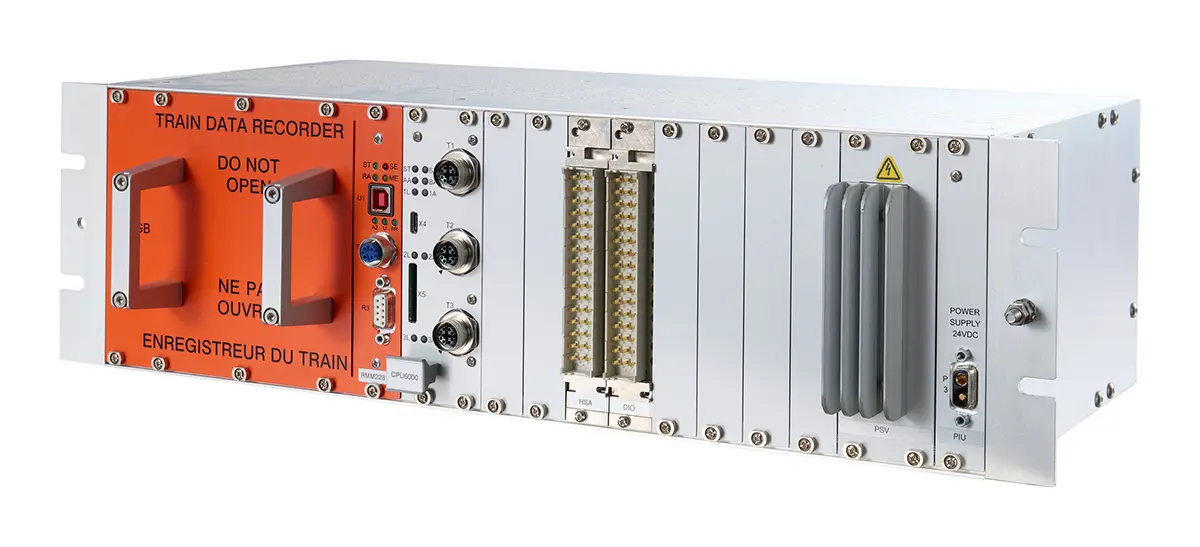
Trains generate large amounts of operational data during normal service. This data provides valuable insight into how the train and its systems behave over time. An Event Recorder is a system that captures and stores this data. It acts as the train’s memory, recording events, signals, and system states for later analysis.
Event Recorders play a key role in fault investigation, maintenance, and safety reviews.
Why trains use Event Recorders
When an incident, fault, or unexpected behaviour occurs, engineers need accurate information.
Relying on assumptions or partial data can lead to incorrect conclusions.
An Event Recorder provides an objective record of what happened before, during, and after an event.
This helps operators and manufacturers to:
- Investigate incidents and near‑misses
- Analyse system behaviour during faults
- Support maintenance and troubleshooting
- Improve system reliability and availability
- Meet regulatory and contractual requirements
What an Event Recorder does
An Event Recorder continuously monitors selected signals across the train.
These signals may include:
- Control system states
- Driver inputs
- Train speed and direction
- Brake and traction commands
- Network traffic and messages
- Status of connected sub‑systems
All data is time‑stamped and stored in secure memory. Older data is overwritten in a controlled way once storage limits are reached.
Types of data recorded
Event Recorders collect different kinds of data depending on the application and system design.
Event and time‑based data
An Event Recorder records data related to driver actions and onboard system behaviour.
- Event data captures changes of state, such as control inputs or system status transitions.
- Time‑based data records continuously varying parameters by storing sampled values with a time reference. This allows the sequence of events and system behaviour to be reconstructed before, during, and after an incident.
Network and system data
In networked control systems, Event Recorders may capture communication traffic.
This helps diagnose issues related to timing, message loss, or data conflicts.
How Event Recorders are used
Event Recorder data is typically retrieved during maintenance or after an incident. The data can be analysed using dedicated software tools. These tools present information in a clear, structured format.
Common use cases include:
- Reconstructing the sequence of events leading to a fault
- Verifying correct system behaviour
- Supporting warranty and liability investigations
- Providing evidence for safety assessments
Because the data is factual and time‑stamped, it supports objective decision‑making.
Event Recorders and safety
In safety‑critical applications, Event Recorders provide traceability. They allow operators to demonstrate how systems behave in real operating conditions. This is important for safety reviews, audits, and continuous improvement activities.
Event Recorders do not control the train. They observe and record what the control systems are doing.
This separation ensures that recording functions do not interfere with train operation.
Event Recorders in a train system architecture
Event Recorders are typically integrated into the train’s control and monitoring system.
They may receive data from:
- Vehicle Control Units
- Remote Input/Output systems
- Communication networks
- Sub‑systems such as doors, brakes, or traction
This integration allows a single recorder to capture data from across the train.
Compliance With Railway Standards
Event Recorders used in train applications are designed to comply with recognised railway standards.
Typical standards include:
- EN 50155: Electronic Equipment on Rolling Stock
- EN 45545: Fire Protection on Railway Vehicles
- IEEE 1482‑1.1999: Standard for Rail Transit Vehicle Event Recorders
- IEC 62625‑1: Electronic Railway Equipment – On-board Driving Data Recording System
- GM/RT2472‑1.2002: Data Recorders on Trains – Design Requirements
Adherence to these standards helps ensure the Event Recorder performs reliably in demanding train environments and supports safety, maintenance, and investigation activities.
What is inside an Event Recorder?
Although Event Recorders can be implemented in different ways, there are common components.
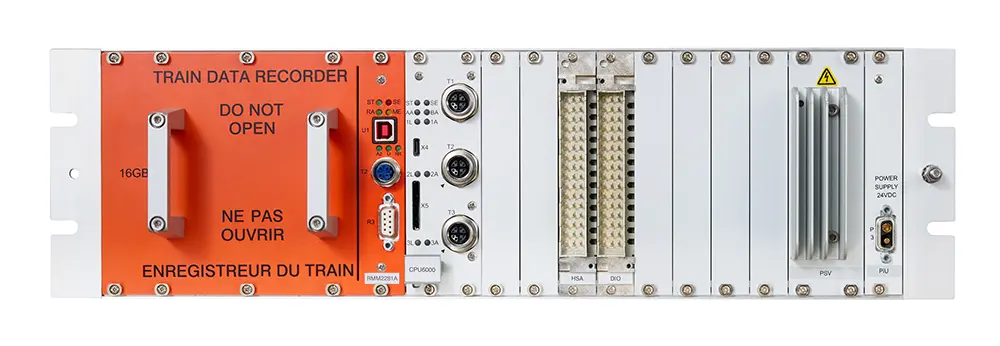
Typical Hardware Components
- Data acquisition interfaces
Event recorders are required to record driver behaviour and on-board system behaviour. Therefore, it needs to acquire signals from onboard systems and controls. These signals could be digital, analog or network based.
- Processing Unit (CPU)
The Processing Unit (CPU) is the central control element of the Event Recorder. It manages the flow of data from onboard systems and driver interfaces, ensuring information is captured, time‑stamped, and organised correctly before being stored. The CPU coordinates event and time‑based recording, applies the system time reference, and controls how data is written to non‑volatile memory. It also supports data retrieval by preparing recorded information so it can be extracted and analysed during fault investigation, incident reviews, or maintenance activities.
- On‑board data storage (protected memory)
On‑board data storage provides secure, non‑volatile storage for event and time‑based data. It is designed to retain recorded information reliably under vibration, temperature extremes, and power interruptions typical in train environments. The module ensures data integrity so information can be retrieved and analysed after faults, incidents, or maintenance activities.
- Data retrieval interface
A data retrieval interface enables recorded data to be retrieved for investigation and monitoring.
- Power Supply Unit
A dedicated power module converts the vehicle’s supply voltage into stable, filtered power suitable for electronics. It also manages protection against surges, transients, and voltage drops typical in rolling stock environments.
- Industrial‑Grade Rack or Housing
The mechanical structure is built to railway standards for vibration, shock, fire‑safety, and EMC. Racks also provide physical slots, connectors, and grounding paths for the data acquisition modules.
Benefits for Train Builders and Operators
An Event Recorder provides clear benefits for train builders and operators:
- Faster fault investigation: Time‑stamped data helps identify what happened before, during, and after an incident.
- Support during commissioning and acceptance: Recorded data helps verify system behaviour and resolve issues during testing and handover.
- Improved operational insight: Operators gain visibility into how trains and onboard systems perform in daily service.
- Reduced downtime: Clear evidence shortens troubleshooting and supports quicker maintenance decisions.
- Lifecycle support: Consistent data improves collaboration between train builders and operators throughout commissioning, warranty, and service life.
Summary
An Event Recorder provides a reliable, time‑based record of what happens on a train. It supports fault investigation, maintenance, and safety activities by turning operational data into usable information.
By recording events and system behaviour, Event Recorders help operators and manufacturers understand their trains better and make informed technical decisions.
Why Choose EKE Electronics for your Event Recorder
Customers choose EKE‑Electronics for Event Recorders because they are built on the proven EKE‑Trainnet® platform, using a modular approach that supports long train lifecycles and changing project requirements. EKE-Trainnet® Event Recorders can be configured to record only the signals that matter, integrated with other onboard systems in the same rack, and expanded as needs evolve. With decades of experience working closely with train builders and operators, EKE-Electronics provides not just hardware, but practical engineering support throughout design, commissioning, and service life, helping customers maintain clear visibility into train behaviour without unnecessary complexity.
Our work is supported by recognised quality and safety certifications, including ISO 9001 and IRIS, along with established processes for functional safety and cybersecurity.