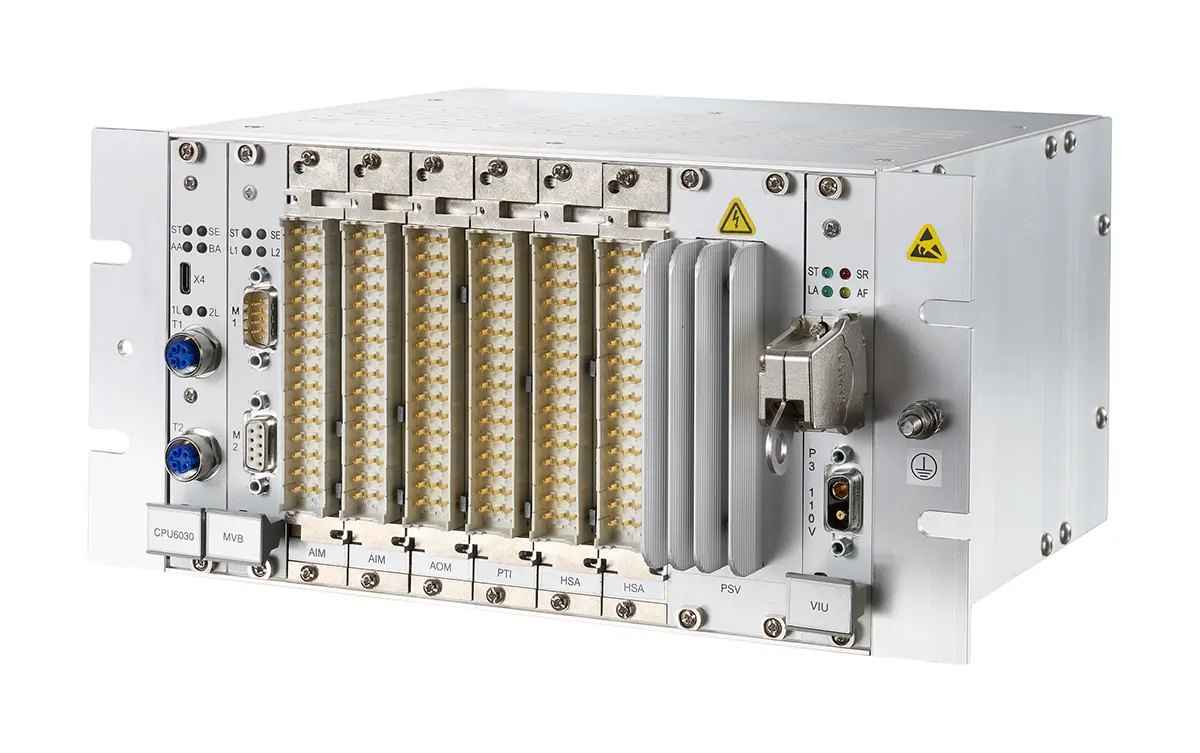
Trains rely on thousands of signals. All these signals need to travel reliably to the train’s control system so it can make the right decisions at the right moment. This is where the Remote Input/Output (I/O) Module, commonly known as a RIOM, becomes essential.
A Remote Input/Output Module, or RIOM, collects data from local sensors and equipment on a train. The module forwards this information to a central control system such as a Vehicle Control Unit or a Train Control and Monitoring System. RIOM hardware also transmits commands from the control system back to equipment located around the vehicle.
Why Trains Use RIOMs
Trains contain large numbers of devices that need monitoring and control. Direct wiring from every device to the central computer would require heavy harnesses and complex installations.
A RIOM solves this by sitting close to the equipment it manages. Instead of dozens of long cables, the RIOM gathers all local signals and sends them through a small number of data connections. This approach:
- Reduces cabling
- Lowers installation and lifecycle costs
- Simplifies troubleshooting
- Improves reliability and maintainability
What a RIOM Does
A RIOM can handle both input and output signals:
Inputs
- Digital inputs such as door‑closed sensors, brake indications, or switch statuses
- Analog inputs such as current, voltage, temperature, or vibration measurements
- Specialised inputs such as frequency or pulse‑width measurements
Outputs
- Digital outputs for controlling devices (e.g., activating relays or safety loops)
- Analog outputs where required
- Module‑specific outputs used in certain train applications
Each module inside a RIOM rack focuses on a specific task, such as analog acquisition, digital control, temperature sensing, or safety‑related monitoring.
Digital and Analog Inputs and Outputs
Remote Input/Output Modules are built to handle a wide variety of signals found throughout a train. These signals fall into two main categories: digital and analog. Understanding the difference helps explain why RIOMs are so versatile in controlling and monitoring on‑board systems.
Digital Inputs
Digital inputs represent signals that have only two possible states, such as on/off, open/closed, or active/inactive. Examples include:
- Door‑closed contacts
- Brake applied/released indications
- Switches and interlocks
- Safety loop statuses
A digital input simply reports whether the condition is true or false. RIOMs collect these states and pass them on to the control system so it can make decisions.
Digital Outputs
Digital outputs allow the RIOM to control equipment by switching something on or off.
Typical uses include:
- Activating relays
- Switching lights or indicators
- Enabling or disabling subsystems
- Driving control loops or interlocks
Digital outputs are essential when the train’s control system needs to send a clear, binary command.
Analog Inputs
Analog inputs capture values that vary over a continuous range rather than in steps.
Common examples are:
- Temperature measurements
- Voltage signals
- Current signals
- Pressure or force measurements
- Frequency or pulse‑width signals
Because these values change gradually, analog inputs allow the RIOM to monitor conditions such as equipment temperature, electrical behaviour, or mechanical performance in a more detailed way.
Analog Outputs
Analog outputs are used when a system requires the RIOM to send a continuously variable signal. These can be used for:
- Controlling devices that respond to proportional electrical signals
- Driving actuators that require a specific voltage or current
- Providing reference levels to equipment that calibrates or adjusts automatically
Although analog outputs are not needed on every train, they play an important role in applications where precise control or modulation is required.
Designed for Train Environments
Train conditions place strong demands on electronic hardware. RIOM have to meet industry requirements for shock, vibration, temperature, electromagnetic compatibility, and fire safety. They support communication protocols, including MVB and TRDP to match different train architectures.
Many RIOM systems also offer redundancy. This means two processing cards can work together to ensure that if one fails, the other continues operating. Redundancy is essential for systems that perform safety‑related functions on SIL 2 certified applications.
Compliance With Railway Standards
RIOM systems are developed to meet the major international standards required for electronic equipment on rolling stock. This ensures stable operation across harsh railway conditions and compatibility with modern TCMS architectures.
Typical standards include:
- EN 50155: Electronic Equipment on Rolling Stock
- EN 45545: Fire Protection on Railway Vehicles
- IEC 61375: Train Communication Network (TCN)
- IEC 61131: Programmable Controllers
Safety‑related RIOM variants are built for applications requiring SIL 2 functional safety, using certified modules. These systems also use safety‑critical communication methods like SDTv2 to ensure the integrity of measurement and monitoring data
Compliance with these standards allows RIOMs to be deployed confidently in areas such as bogie monitoring, brake supervision, temperature sensing, and critical digital I/O control.
Safety‑Related Remote I/O Modules
In many train applications, the equipment connected to a Remote Input/Output Module is responsible for functions that affect the safe movement of the train. Examples include temperature monitoring, bogie stability measurements, door interlocks, brake supervision, and emergency‑related signals. When these functions contribute to overall train safety, the I/O modules handling them must meet defined functional‑safety requirements.
Safety‑related Remote I/O Modules are designed to comply with standards such as
- EN 50126: Reliability, Availability, Maintainability and Safety for railway systems.
- EN 50129: Safety‑related electronic signalling systems.
- EN 50716: Software for railway control and protection systems.
These standards define how systems achieve and demonstrate Safety Integrity Levels (SIL). A common requirement for rolling stock is SIL 2. This ensures that system behaviour remains predictable and dependable even if components fail.
To meet these requirements, safety‑related Remote I/O Modules typically use:
- Certified hardware channels for digital and analog signals
- Redundant architectures or diverse processing paths
- Self‑diagnostics to detect abnormal states or internal faults
- Safe communication protocols, such as specialised variants of MVB or Ethernet‑based messaging. These include integrity checks, time supervision, and redundancy management
These design measures ensure that the data used for safety‑relevant decisions remains accurate and trustworthy throughout the train’s control network.
Because of this enhanced integrity, safety‑rated Remote I/O Modules can be used confidently in applications such as:
- Monitoring bogie temperature, vibration, and mechanical stability
- Supervising brake states and safety loops
- Detecting conditions that require protective action
- Handling critical digital I/O where incorrect states could cause unsafe outcomes
By supporting these functions reliably, safety‑related Remote I/O Modules help train control systems maintain safe operation under a wide range of operating and fault conditions.
What’s Inside a Remote Input/Output Module (RIOM)?
Although RIOMs come in many forms depending on the train architecture and supplier, most share a common set of hardware building blocks and software components.
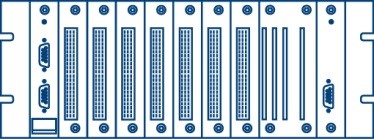
Typical Hardware Components
1. Processing Unit (CPU Card)
The processor handles local logic, diagnostics, timing, and communication with the train network. It also supervises the health of the I/O modules and manages data exchange with the central control system.
2. Communication Interfaces
To integrate into different train architectures, RIOMs usually include one or more communication interfaces, such as:
- Ethernet‑based train networks (ECN, TRDP)
- MVB (Multifunction Vehicle Bus)
- CAN or serial links
These interfaces allow the RIOM to send its I/O data to the train’s TCMS or VCU and receive commands in return.
3. I/O Modules
The core function of a RIOM is to read and write signals. Modules are typically grouped by type:
- Digital input modules for on/off or open/closed signals
- Digital output modules for switching relays or controlling devices
- Analog input modules for temperature, voltage, current, pressure, or vibration
- Analog output modules for proportional control
These modules are modular so they can be mixed and matched depending on the train’s needs.
4. Power Supply Unit
A dedicated power module converts the vehicle’s supply voltage into stable, filtered power suitable for electronics. It also manages protection against surges, transients, and voltage drops typical in rolling stock environments.
5. Industrial‑Grade Rack or Housing
The mechanical structure is built to railway standards for vibration, shock, fire‑safety, and EMC. Racks also provide physical slots, connectors, and grounding paths for the I/O and communication modules.
Where RIOMs Are Installed
Because RIOMs are modular and scalable, they can be installed throughout the vehicle. Common locations include:
- Door control areas
- Bogies
- HVAC units
- Brake control areas
- Powerheads or motor cars
- Cab equipment zones
Having multiple RIOMs distributed around the train ensures that signals are collected efficiently, even in long or multi‑car vehicle sets.
Benefits for Train Builders and Operators
A RIOM provides clear advantages across the lifecycle of a train:
- Flexibility: Modules can be added, removed, or replaced depending on project needs.
- Ease of integration: Supports a wide range of sensors, actuators, and protocols.
- Reduced downtime: Diagnostics, LED indicators, and centralised monitoring help crews identify issues quickly.
- Future‑proofing: New modules or configurations can be introduced without redesigning the entire control architecture.
Summary
A RIOM is a key building block in train control systems. It gathers and sends vital data, simplifies wiring, and improves maintainability. These functions help train operators achieve reliable and safe performance across the entire train lifecycle.
Why Choose EKE-Electronics for your RIOM
Choosing the right Remote Input/Output architecture is an important step in building a reliable train control system. EKE-Electronics has 40 years of experience in train automation for both new and legacy fleets. We bring a practical understanding of real‑world operating conditions, system integration challenges, and lifecycle requirements. This background offers practical assurance that our Remote I/O Modules integrate well with a wide range of vehicle architectures and operating conditions.
Our work is supported by recognised quality and safety certifications, including ISO 9001 and IRIS, along with established processes for functional safety and cybersecurity.
Whether you are modernising existing rolling stock or developing a new fleet, partnering with a supplier that understands TCMS integration, functional‑safety expectations, and long‑term maintainability offers a solid foundation. With the right expertise behind your Remote I/O strategy, you can build control systems that are robust, scalable, and ready for the demands of train operations