
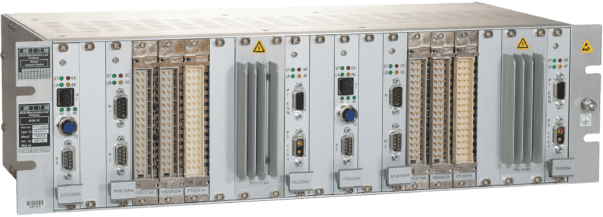
A Vehicle Control Unit (VCU) is the central computing system that keeps a modern train running smoothly. It connects subsystems, manages control logic, collects data, and supports safe and efficient operations. Although highly technical inside, its purpose is simple: to ensure the train behaves reliably and predictably under all conditions.
Function and Purpose
A VCU manages a wide set of tasks that support reliable train operation:
- Subsystem Coordination
Trains consist of several independent systems. This includes doors, brakes, HVAC, traction, lighting, and others. The VCU exchanges information with each subsystem and ensures they behave in a synchronised and predictable manner.
- Control Execution
The unit runs applications that implement control logic. These applications process sensor data and determine when to activate or adjust specific functions such as braking sequences, door unlocking, or automatic mode transitions.
- Communication Handling
The VCU communicates with other devices through standard railway communication networks. To integrate different subsystems, the VCU supports various bus technologies, such as:- WTB
- MVB
- CAN
- Serial links
- Ethernet
The VCU sends and receives data frames that allow the vehicle to operate as a unified system.
- Driver Interaction
Information from the VCU is presented to the driver to support manual or automatic control. The VCU may provide alerts, system states, warnings, or recommended actions.
- Diagnostics and Monitoring
A VCU collects fault data, logs events, and monitors subsystem health. This information is used for maintenance planning and troubleshooting. It helps technicians identify issues more quickly and understand long term performance trends.
Architecture and Capabilities
VCUs are designed for demanding conditions and continuous operation. Key characteristics include:
- Real Time Processing
The VCU responds to inputs within predictable time windows to maintain safe operation. This is critical for functions like braking control or traction adjustment.
- Redundancy and Safety
Many VCUs support safety critical functionality. They may include redundant processors or safety rated components to meet industry safety standards.
- Interfaces and Input/Output
A typical VCU includes digital inputs, digital outputs, analogue channels, and high speed interfaces. These connections allow the unit to gather data from sensors and send commands to actuators.
- Scalability
VCUs are often modular so they can be adapted to different vehicle configurations or upgraded over time. This helps operators extend the lifetime of rolling stock.
- Cybersecurity Considerations
As modern trains rely heavily on data exchange, the VCU must incorporate methods for secure communication and controlled access. This may include secure boot, encrypted communication, or integration with intrusion detection systems.
Hardware and Software Inside a VCU
A typical VCU includes:
- CPU modules
- Interface modules (MVB, WTB, CAN, Serial, Ethernet)
- Power supply units
- Industrial-grade racks
- Application software
Compliance With Railway Standards
- EN 50155: Electronic Equipment on Rolling Stock
- EN 45545: Fire Protection on Railway Vehicles
- IEC 61375: Train Communication Network (TCN)
- IEC 61131: Programmable Controllers
Why Choose EKE Electronics for Your VCU
EKE Electronics bring 40 years of experience in train automation. This makes them a practical choice for train vehicle control units. With systems operating in rail networks across more than 35 countries, this demonstrates broad compatibility with diverse operating conditions.
Our long history is supported by recognised industry certifications such as ISO 9001 and IRIS. EKE-Electronics have established processes for SIL 2 safety and cybersecurity, which help ensure VCUs meet the expectations of modern rail operations. Combined with their capability to deliver complete TCMS solutions when required, this background provides a steady foundation for selecting a VCU that is dependable and compatible with diverse operating environments.