LAM: Lateral Acceleration Monitoring
Build a Lateral Acceleration Monitoring System using the following modules
Click on an image to explore related content.
Modular Concept
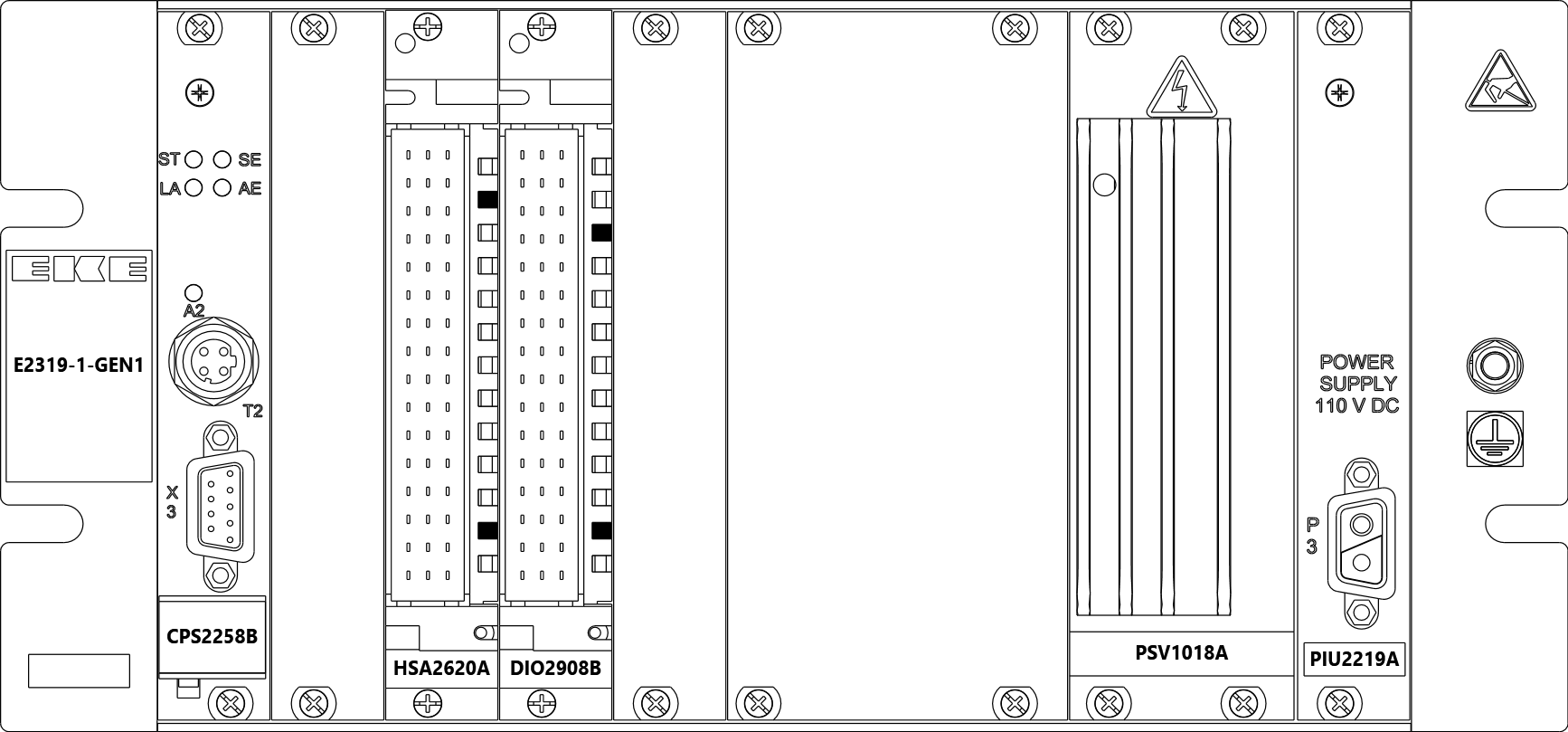
Below is an example of an LAM system made up of a selection of common modules. The modules are the minimum required for LAM. Additional modules are available for expanded functionality. For example, HABD is often integrated within the same system. Hover over each area to view a brief description or click to access the full module page.
CPU with Serial Links (CPS)
A central processing unit providing serial communication interfaces.
High Speed Analogue Input Module
Provides a standard interface for analogue input signals.
Digital Input Output Module (DIO)
Receives digital signals through its input channels and delivers them to the train computer’s Central Processing Unit (CPU) module for processing.
Choose the appropriate input output module to capture the signals you need.
Power Supply Unit for VME (PSV)
Provides power for the system.
Power Input Unit (PIU)
Used to pass train battery voltage to the EKE-Trainnet® Power Supply Unit for VME (PSV) module
Application Software
The Lateral Acceleration Monitoring application software is built on an open-source Linux platform and is coded in C and C++.
Unlike our TCMS platform, which allows users to code their own applications, the Lateral Acceleration Monitoring application software is built by EKE-Electronics. This protects the SIL 2 certification, which demands strict control of tools, processes and engineering methods.
Lateral Acceleration Monitoring Overview
The Lateral Acceleration Monitoring system works by measuring vibrations. Vibrations can have multiple sources, including engines, suspensions, wheelsets and tracks. Accelerometer sensors are placed in the bogie or on the car body. As the train travels, the vibrations are measured.
How the LAM system operates
- Measure: Accelerometers are installed in the axle box or on the car body. These sensors record vibration levels generated during train operation.
- Convert: Recorded vibration signals are converted into lateral acceleration values. This conversion creates a clear numerical picture of the vehicle’s lateral movement
- Assess: Calculated lateral acceleration values are assessed against defined thresholds.Â
- Alarm set:Â A notification is generated when the measured vibration exceeds acceptable limits.
- A threshold can trigger an alarm for the maintenance team.
- A threshold can activate a defined safety function, such as initiating the train’s emergency stop.
Lateral Acceleration Monitoring Core Capabilities
Lateral Acceleration Monitoring supports proactive maintenance through several focused capabilities. The system analyses real‑time lateral movement data to identify developing issues within critical assets. Configurable alarm levels create clear thresholds that highlight abnormal behaviour before performance degrades.
Real-time data processing
-  Captures and processes lateral acceleration in real time using methods aligned with UIC 518:2009.
- Continuous sampling ensures consistent measurement across all operating conditions.
- Real‑time data helps maintenance teams identify and respond quickly to emerging issues.
Configurable alarm levels for predictive maintenance.
- Configure multiple alarm levels to match safety thresholds and operating rules.
- Set threshold values according to recognised standards or based on validated online tests.
- Use escalation: lower levels alert maintenance teams; higher levels can trigger automated actions.
- Most anomalies are detected early, enabling planned maintenance and reducing unplanned downtime.
- Customisable settings ensure relevant alerts for each fleet, route and environment.
Build with redundancy
- Add redundancy to increase availability.
- Backup components preserve data flow and monitoring in the event of a component fault.
- Continuous monitoring reduces missed detections and supports dependable operation.
Why Choose EKE-Electronics for your Lateral Acceleration Monitoring?
EKE‑Electronics brings established technical expertise of safety‑critical rail environments. The LAM solution reflects experience gained 40 years of experience across diverse fleets and long‑term system work.
The LAM platform is engineered by teams with extensive experience in system integrity and reliable lifecycle management
Compliance with Safety Integrity Levels and the EN 50126, EN 50128, and EN 50129 standards provides a structured basis for dependable system behaviour.
The LAM system reflects a clear focus on your operational priorities. A modular design allows the solution to address specific pain points with targeted functionality.
Each module supports consistent service delivery and strengthens long‑term customer trust. The platform empowers teams to improve performance through actionable operational insights.
maintenance
The LAM system detects abnormal behaviour before it becomes a safety risk. Early detection supports uninterrupted service and consistent passenger comfort.
Wheelset condition insights help maintenance teams plan tasks with greater accuracy. Track damage indicators also support more efficient scheduling of essential work.